TECHNICAL ARCHITECTURE
A governed foundation for connected intelligence.
For technical evaluators, the important questions are how information moves, where authorization is enforced, how decisions are supported by evidence, how external knowledge is kept distinct from private information, and how actions are checked before the platform learns from them.
This page describes Ceryvra’s intended high-level architecture and the responsibilities of its principal components. It is a reference design, not a statement that every integration or capability has completed production acceptance.
SYSTEM OVERVIEW
One platform, several deliberately separated responsibilities.
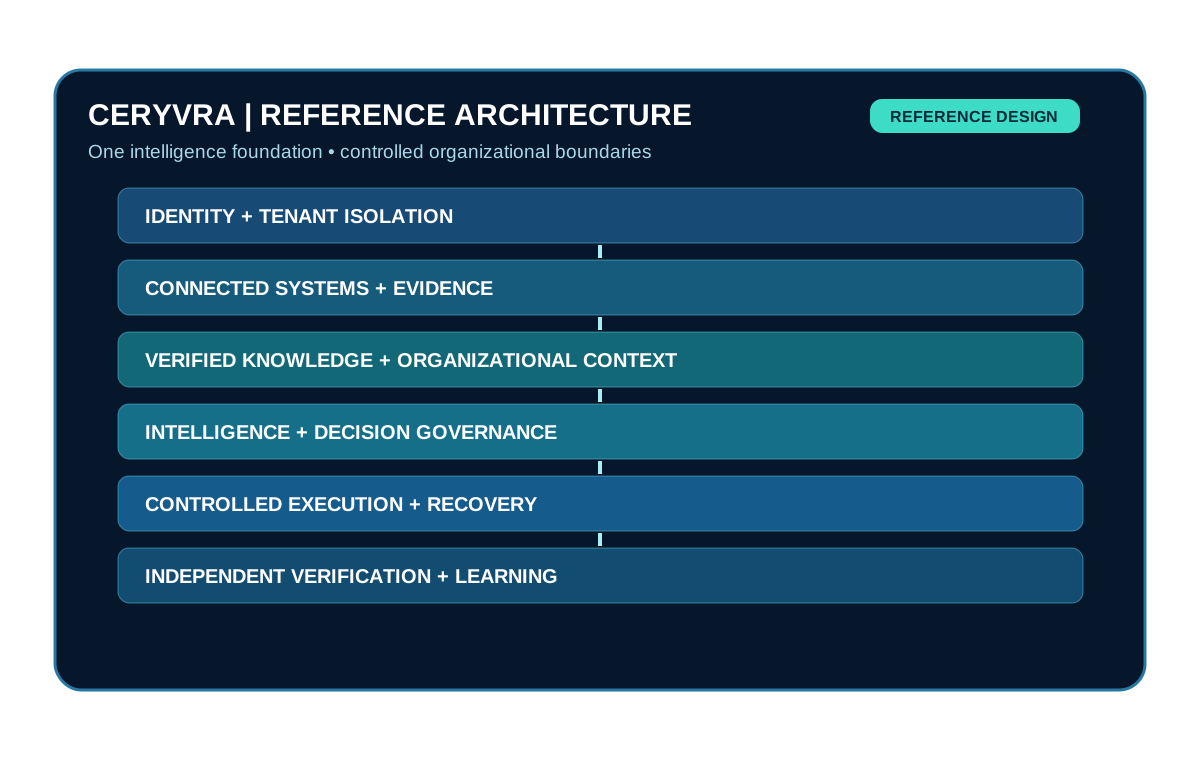
At a high level, Ceryvra is designed as a multi-tenant enterprise intelligence platform with a shared application foundation and controlled separation of customer information. The platform is intended to integrate identity, authorization, information retrieval, domain knowledge, decision analysis, policy enforcement, workflow execution, recovery, and independent verification. These concerns work together, but they must not be collapsed into a single unconstrained AI interaction.
The intended engineering stack includes a modular backend architecture, web-based user experiences, persistent relational records, vector-supported retrieval where appropriate, and managed integrations with authorized business systems. The architecture also needs observable events, deployment controls, and explicit acceptance testing. Particular hosting, cloud, and connector choices depend on the implementation configuration and the signed engineering scope.
A key design principle is that the AI component can assist with investigation, explanation, and proposed plans, but it should not possess unrestricted operational authority. A separate policy and execution path determines whether an action is permitted, what approvals or evidence are required, and whether the result can be considered verified.
KNOWLEDGE & CONTEXT
External industry intelligence is not the same as customer data.
Ceryvra’s planned knowledge architecture includes a centrally maintained foundation of relevant industry practices, verified requirements, and other appropriately sourced external information. That shared foundation is intended to provide useful context from the first day of an implementation, rather than waiting for each customer to build all foundational knowledge from nothing. Coverage and verification must be represented accurately: a target number of records is not the same as completed, current, validated knowledge.
An organization’s own records, processes, history, exceptions, and operational relationships form a separate tenant-isolated context. The platform should retrieve and combine only information it is permitted to use and keep provenance attached to significant facts. When sector-specific guidance and local operational reality differ, the platform must examine the conflict rather than silently choosing whichever statement sounds most persuasive.
External learning should be curated around relevance, reliability, provenance, recency, and change detection. It is not intended to ingest unrestricted internet material and treat it as truth. Private-installation synchronization, where supported, would require controlled and authenticated updates that respect the customer’s data boundaries.
DECISION INTELLIGENCE
A governed path from understanding to proposed action.
The decision layer is intended to construct a contextual picture of the situation, evaluate current evidence, identify relevant expectations and dependencies, anticipate possible consequences, and develop alternative approaches. The system can combine deterministic checks with model-assisted analysis, but important rules, entitlements, and execution decisions should not rely solely on free-form generative text.
Ceryvra’s broader framework includes organizational and consequence relationships, evidence obligations, targeted revalidation when relevant conditions change, and the ability to revisit a decision when new information undermines the basis of a prior conclusion. Proposed improvements can be simulated and compared for expected benefits, costs, uncertainties, and secondary effects before an organization approves any change.
UME is intended as the broader intelligence experience over the shared platform foundation, including advanced anticipation, simulation, and evolving capabilities. Simpler product experiences can be governed through entitlements within the same underlying codebase rather than maintaining fundamentally separate intelligence engines for every industry.
CONTROLLED EXECUTION & RECOVERY
Governance cannot end when an action starts.
Ceryvra’s QEP mechanism is intended to qualify and govern execution through the defined lifecycle conditions, required evidence, and appropriate authorization. EFAR addresses accountable exception handling and recovery when the proposed workflow encounters unexpected conditions, integration failures, or changes that require the system to pause, revise, or escalate. These controls are meant to preserve traceability while avoiding uncontrolled retries or silent changes in authority.
Execution through third-party systems should be constrained to supported connectors and authorized operations. A write operation is not considered successful simply because an API call was attempted. The intended implementation must handle failures, partial completion, idempotency, audit events, compensating steps where appropriate, and the possibility that human intervention is needed. The design should fail closed when critical authorizations or tenant boundaries cannot be established.
The specific nine-stage QEP implementation, interface contracts, and recovery behavior should be verified against the controlling engineering definitions and live integration tests. This architectural overview intentionally avoids inventing a stage name or asserting an unverified production capability.
INDEPENDENT VERIFICATION
Proof of outcome remains distinct from execution.
FEER is the intended independent verification and evidence-reconciliation mechanism. Its role is not to merely monitor whether a process ran, but to assess whether the evidence supports the required outcome and whether relevant obligations were met. When evidence is missing, contradictory, or stale, the system should represent that state explicitly and support appropriate revalidation or reopening instead of promoting an uncertain result to verified status.
That distinction matters for both operational and regulatory confidence. A job might complete but produce the wrong record, or a status indicator might be green while customers remain affected. An independent evidence-based check provides a separate basis for determining whether an action actually achieved the required result. Verified conclusions can then be used to update the platform’s organizational learning without treating unfinished tasks or plausible predictions as confirmed facts.
ARCHITECTURE ACCEPTANCE
What technical buyers should be able to validate.
A successful implementation needs more than an architecture diagram. Engineering acceptance should include real identity and permission tests, cross-tenant isolation testing, connector write-and-read-back verification, policy enforcement, recovery demonstrations, independent evidence checks, relevant data migration controls, and operational monitoring. AI requests should pass through the governed gateway and respect information-handling policies configured for the customer.
For deployments involving sensitive information or regulated activities, the customer and implementation team also need to establish data-handling boundaries, retention expectations, human-approval rules, operational ownership, and procedures for responding to failures. Ceryvra’s architecture is intended to make those controls possible and observable; individual legal or compliance outcomes must still be evaluated in the real operating environment.
This page is a high-level technical description. It does not expose sensitive implementation details or claim that planned modules, proprietary mechanisms, external knowledge coverage, or integrations have been fully certified before the corresponding evidence is available.
LET'S TALK ABOUT YOUR BUSINESS
Let’s have a technical conversation.
Discuss system integrations, tenant isolation, governance, architecture dependencies, and the validation required for your environment.
Start a conversation