SOLUTIONS
Real challenges. Better ways forward.
Ceryvra is not designed for only one industry or one department. The same underlying approach—understand the problem, evaluate options, act with permission, and verify results—can be applied to many different types of work.
What changes is the context. A business needs recommendations that reflect its people, policies, systems, priorities, and the expectations of its industry. The examples below show how that could look in practice.
START WITH THE PAIN POINT
What keeps getting in the way of good work?
Many organizations know something needs to improve but struggle to determine where to begin. A team might be working overtime while customers still wait too long. A school district may have multiple systems holding important details about student services, yet still find it difficult to coordinate work. A healthcare organization may recognize scheduling pressure but lack a clear view of the causes across facilities and departments.
Ceryvra is designed to approach these challenges from the business problem first. It would examine information the organization has authorized, identify relevant constraints, compare potential causes, and recommend reasonable next steps. Some improvements may require a process change; others may involve better communication, smarter resource allocation, or an approved automation. The intent is not to force a technology solution where a simpler operational solution would work.
EXPLORE A POSSIBLE SCENARIO
What could Ceryvra help your team solve?
Choose a type of organization to see an illustrative business challenge and how the intended platform would investigate and respond. These are examples, not claims of deployed customer results.
OPERATIONS EXAMPLE
Overtime is rising, but the work is not getting done faster.
A company sees labor costs increasing while customer requests take longer to complete. Managers suspect a staffing problem, but there may be several causes.
Ceryvra could compare staffing patterns, workload, handoffs, recurring rework, and policy constraints. It could evaluate different scheduling and workflow options, identify who must approve them, and determine what evidence would show whether an approved change helped.
The intended benefit is not merely a lower overtime number; it is a clearer explanation of the problem and a defensible path to improvement that considers both costs and service quality.
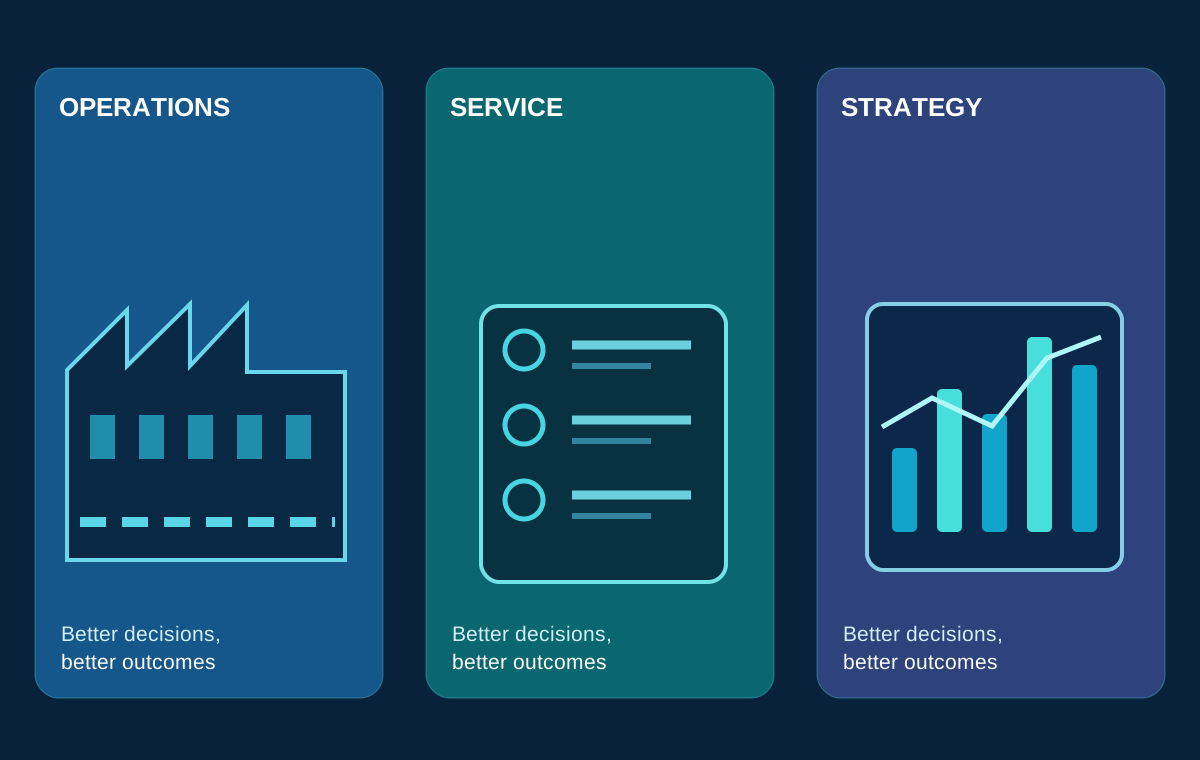
PRACTICAL VALUE ACROSS FUNCTIONS
The opportunity is larger than one department.
Finance teams can use a connected view to investigate unnecessary spending, duplicated purchases, contract exposure, or inconsistencies between planned and actual costs. Operations teams can study how schedules, resources, handoffs, and dependencies affect throughput. Customer-facing teams can understand where a service journey breaks down, why requests return for rework, and which changes might improve the experience.
Leadership teams can use the same governed decision approach when prioritizing investments, evaluating trade-offs, or preparing for change. Risk and compliance functions may benefit from evidence-backed assessments of requirements, documented ownership, controlled reviews, and the ability to check whether corrective actions actually resolved the issue. The use case changes, but the value comes from connecting evidence to a decision and then to a measurable result.
Ceryvra’s intended cross-industry knowledge foundation supplies relevant background and expectations, while customer-specific understanding provides the operational context. These should work together without treating a generic industry recommendation as automatically suitable for a particular organization.
WHAT AN IMPLEMENTATION WOULD INVOLVE
Start small enough to prove something meaningful.
An effective first use case does not have to transform the entire organization. It can begin with one recurring delay, an expensive process, an important compliance obligation, or a difficult planning decision. The organization and the Ceryvra team would need to identify the desired outcome, available information, system access requirements, the people responsible for decisions, and the evidence that would count as success.
From there, the relevant integrations and controls can be validated, the workflow can be examined in a controlled setting, and the proposed improvement can be evaluated before broader use. Results should be measured against the original business goal rather than relying on vague claims that an AI system is making the organization smarter. That keeps the conversation grounded in work people can recognize and value.
LET'S TALK ABOUT YOUR BUSINESS
Tell us the challenge—not the technology you think you need.
We can start by understanding what is slowing your organization down or creating unnecessary cost and uncertainty.
Start a conversation